 and detail the students surname and first initial within the appropriate text boxes and select the ‘Search’ option.
Person Details
The following Helptext is applicable for Studentship Details.
You may scroll down this page or use the quick links below to take you to the appropriate Helptext section:
Person Details
Equality and Diversity Data
Select the underlined option and detail the students surname and first initial within the appropriate text boxes and select the ‘Search’ option.
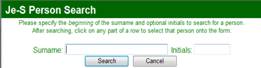
Students who already have a Je-S account (it is very unlikely that they will) can be selected by choosing Select Person, and searching on their surname and/or initials. Once a person has been selected, the boxes will populate with the data already stored in the Je-S database.
Select the “Save” option from the top of the screen, which will save the persons details to the Je-S form.

In most cases the search will not find the student from the search results, in which case, the student’s details will have to be added manually. Please follow the initial process (detailed as above) for searching the Je-S database.
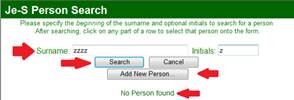
After the results are returned, please select the Add New Person  option which will be displayed below the ‘Search’ and ‘Cancel’ options. Please then complete the fields. Forename 1 and Surname are mandatory fields.
Title: If ‘Other’ is selected, please enter the title you associate with in the free-text box, otherwise leave the box blank.
Preferred form of address (Not available in all Research Council Forms)
Please provide details if the student has indicated a preferred form of address.
Address
The postal address details should reflect departmental/institutional contact details rather than the student’s home address. The Address Line 1, Town/City and Postcode (if UK) are mandatory.
Note: Correspondence from Research Councils to students is likely to be about funded courses or possibly asking for views about funded postgraduate training. Students may also be invited to events or conferences that the Research Councils fund. Please ensure that the students know what details have been recorded and they are aware of how this information will be used by the Research Organisation and the Research Councils or a third party working on their behalf.
Please then complete the remaining personal information for the student:
Contact Details
This field is mandatory. Personal or university e-mails may be entered, and addresses should be entered in a valid format, i.e. email.address@university.ac.uk . Generic university email addresses cannot be entered.
Telephone
Telephone details should reflect departmental/institutional contact details.
Equality and Diversity Data - see Background information below
The following information is requested. Please select from the drop down list
·
Date of Birth (the information can be entered manually in the format DD/MM/YYYY or by selecting from the calendar icon)
Gender - select from the drop down list
Ethnic origin - select from the drop down list
Country of nationality - select from the drop down list
Disability indicator; select No, Yes or Not Disclosed
Disability
Disability Indicator, "Yes" option selected: If the student has indicated that they have a disability, when the Yes option is selected on screen, the form will require the selection of one of the disability options displayed within the drop down list.
Once the details have been entered, select the 'Save' option from the top of the screen, which will save the person details to the Je-S form.
Equality and Diversity Data - Why do we ask for this information and what do we use it for?
In line with good practice and legal requirements, the Research Councils collect data on equality and diversity from Award holders, including those holding studentship awards. This data helps in assessing how effective our policies and procedures are in eliminating unlawful discrimination and promoting equal opportunities. This information will be used anonymously for statistical purposes. It will be treated in confidence and in line with the Councils’ data protection procedures. It will not be used in the assessment of applications.
Under each heading users can choose not to disclose the information but it will help us to monitor equality of opportunity if it is provided.
The information we ask for is as follows:
Date of Birth
Ethnic origin
Country of nationality
Gender
Disability
What is the definition of a disability?
In terms of an understanding of what is meant by a disability, the Research Councils refer to the following extract from the 1999 Quality Assurance Agency for Higher Education Code of Practice – section 3: Students with Disabilities: “Disability covers a wide range of impairments, visual impairments, and specific learning difficulties including dyslexia, medical conditions and mental health problems. Some of these impairments may have few, if any implications for a student’s life or study. Other may have little impact on day to day life but may have a major impact on a student’s study, or vice versa. Some students may already be disabled when they apply to an institution; others may become disabled or become aware of an existing disability only after their programme has started. Others may have fluctuating conditions. Some students may be disabled temporarily by accident or illness”.